























You've just finished cooking a delicious meal. You lower the heat, plate your food, and — out of habit — switch the cooktop off completely. Simple, right?
Not quite. Whether you own a sleek induction cooktop or an infrared cooktop, switching it off the moment you're done is one of the most common mistakes home cooks make. It's a habit that seems harmless but can silently reduce your appliance's lifespan and even create safety hazards in your kitchen.
In this guide, we'll explain exactly what happens inside your cooktop after cooking, why the cooling process matters, and how to power down your appliance the right way.
How Induction and Infrared Cooktops Generate Heat
Before understanding why you shouldn't shut off immediately, it helps to know how these appliances work.
Induction Cooktops
Induction cooktops use electromagnetic fields to generate heat directly in your cookware. The cooktop surface itself doesn't get hot — the pan does. However, the internal electronic components — including the control board, power transistors, and coils — generate significant heat during operation.
Infrared Cooktops
Infrared cooktops use a high-resistance heating element that glows red and radiates intense infrared energy. The glass surface gets extremely hot during and after cooking. This residual heat doesn't vanish the moment you turn the dial.
Both types of cooktops retain substantial internal heat after use. This heat must be safely dissipated before full shutdown — and your cooktop is designed to handle that automatically, if you let it.
The Internal Cooling System: What's Happening Inside
Modern induction and infrared cooktops are equipped with an internal cooling fan and thermal management system. This system kicks in the moment you start cooking and, critically, continues to run for a period after you stop.
The Role of the Cooling Fan
The internal fan draws cool air over the electronic components and expels hot air out of the unit. During cooking, the fan runs continuously to prevent overheating. After you turn the burner off, the fan keeps running until the internal temperature drops to a safe level.
This post-cooking fan operation is not a malfunction — it's an engineered safety feature. Think of it like the cooling fan in a laptop that keeps spinning even after you close a heavy application.
The Heat Dissipation Process
Heat dissipation is the gradual transfer of thermal energy away from sensitive components. After a cooking session, the internal circuit board, IGBT transistors (in induction models), and power regulators are all still warm. Rushing this process by cutting power entirely disrupts the cooling cycle and forces those components to sit in trapped heat.
On infrared models, the glass ceramic surface can retain temperatures above 300°C (572°F) even minutes after the element is switched off.
The Real Risks of Turning Off the Switch Immediately
So what actually goes wrong when you shut everything off too soon?
Electronic Component Damage
Cutting power mid-cool traps heat around the control board and transistors. Repeated thermal stress causes micro-cracks in solder joints and degrades capacitors.
Reduced Appliance Lifespan
Cooktops are designed to last 8–15 years. Consistently forcing abrupt shutdowns can cut that lifespan significantly, leading to expensive repairs or early replacement.
Overheating & Fire Risk
Without the fan completing its cycle, residual heat has nowhere to go. In poorly ventilated installations, this trapped heat can become a genuine fire hazard.
Electrical Hazards
Thermal cycling stress on internal wiring insulation can cause it to crack over time, increasing the risk of short circuits — a serious electrical safety concern.
Control Panel Malfunction
Touch-sensitive control panels are particularly vulnerable to heat. Trapped heat can cause buttons to become unresponsive, show error codes, or fail entirely.
Voided Warranty
Many manufacturers state that failure to follow proper shutdown procedures — including allowing the cooling cycle to complete — may void your warranty.
The Correct Way to Turn Off Your Cooktop
Doing this right takes almost no effort. Here's the proper shutdown process.
-
Lower the power level first
Before switching off, reduce the heat setting to its lowest level a minute or two before you're done cooking. This gives the cooling system a head start.
-
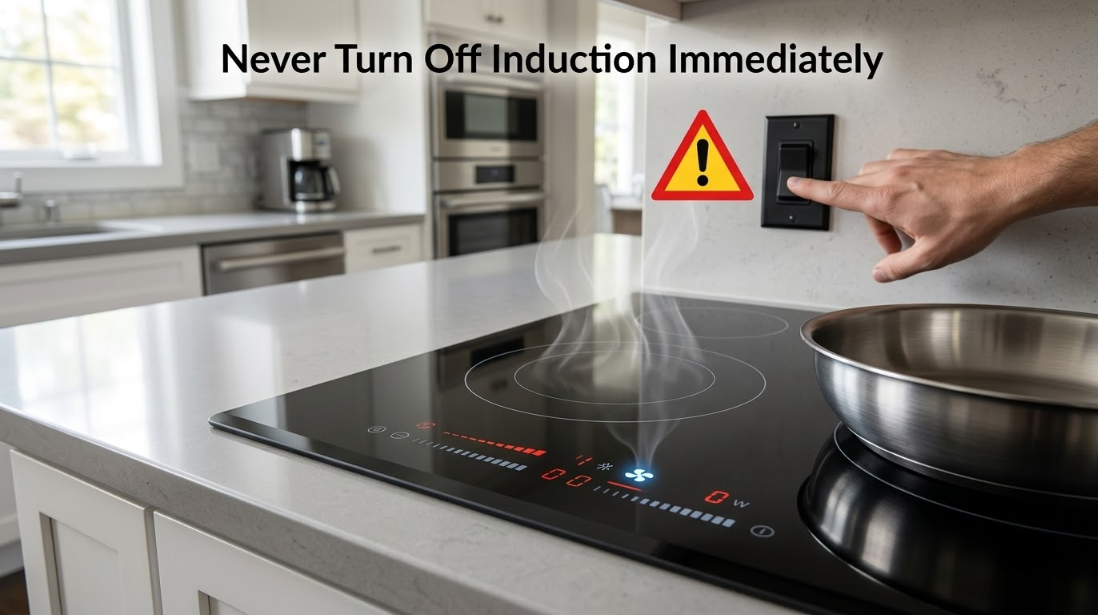
Turn off the burner, not the main switch
Use the cooktop's own controls to turn off the individual burner. Don't immediately cut power at the wall socket or main switch.
-
Let the cooling fan finish its cycle
You'll hear the fan continue to run. Let it run until it stops on its own — typically 2 to 5 minutes depending on the model and cooking duration.
-
Wait for the residual heat indicator to clear
On infrared models especially, wait until the "H" (Hot) indicator light goes off. This confirms the surface has cooled to a safe temperature.
-
Now you can switch off at the main power
Once the fan has stopped and the heat indicator has cleared, it's safe to cut power at the wall or isolator switch if needed.
If the fan is still running, the cooktop isn't done yet. Never cut main power while you can hear the cooling fan operating.
Induction Safety Tips and Maintenance Best Practices
Daily Usage Tips
- Always ensure the cooktop has adequate ventilation — never block the air vents.
- Avoid placing heavy objects on top of the cooktop while it's cooling, as this can trap heat.
- Clean the surface only after it has fully cooled — never use water on a warm surface.
- For induction models, use only cookware with a flat magnetic base to ensure proper heat transfer.
- Don't leave empty cookware on an active induction burner — it raises internal temperatures rapidly.
Regular Maintenance
- Periodically check and clean the cooling vent grilles — dust buildup impairs airflow.
- Inspect the power cord every few months for signs of heat damage or fraying.
- Follow the manufacturer's recommended service schedule, especially for commercial-use models.
- If your cooktop starts making unusual noises or shows error codes, have it inspected by a technician.
Installation Considerations
- Install with minimum clearances specified in the manual — typically at least 10–15 cm on all sides.
- Never install a cooktop directly above a drawer without a proper heat shield.
- Use a dedicated electrical circuit with the correct amperage rating for your model.
Common Questions About Cooktop Cooling
Is it okay to turn off at the wall in an emergency?
Yes — in a genuine emergency such as a fire or electrical fault, your safety comes first. Cut power immediately. These guidelines apply to routine, everyday use.
My cooktop has an auto-off feature. Does this still apply?
Yes. Auto-off features cut the burner power but most models still require the fan cycle to complete. Don't confuse the burner switching off with the appliance being fully powered down.
Final Thoughts: A Small Habit With Big Impact
Your cooktop is built with layers of safety engineering — and the cooling cycle is one of the most important. Allowing those extra few minutes for the fan to complete its work protects your investment, extends the life of your appliance, and keeps your kitchen safe.
The next time you finish cooking, let the fan run its course — and walk away knowing your cooktop is looking after itself, just as it was designed to.